Shopping Cart
There are no more items in your cart

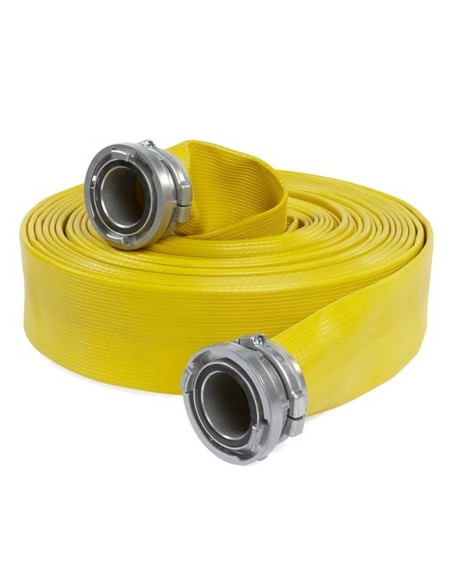


ARMTEX JAFRIB reinforced extruded rubber flat fire hose (m.)
€18.08
€21.27
-15%
Tax included
The reinforced extruded rubber flat fire hose is designed to fight fires efficiently. It has a resistance that is very useful for highly abrasive industries, such as petrochemicals.
Characteristics of the flat fire hose
The extruded rubber is reinforced to resist abrasion and temperatures up to 600 °C. Discover its features:
It is resistant to ozone and exposure to chemical components, to which it remains intact.
Available in brick red, and in other colors, through Electrocchannel
It has the necessary certifications in conjunction with the couplings.
Presented in sections of 15, 30 and 60 m.
Color:

Brick red and yellow are the standard colors. Other colors are available upon request.
Applications:
Specially designed for municipal fire departments, navies, petrochemical plants, nuclear plants and other industrial services. Resistant to oil, chemicals and abrasion.
Construction:
Made from 100% high tenacity circularly woven synthetic yarn, completely protected and enclosed by a tough, highly durable synthetic nitrile rubber and PVC blend, extruded through the fabric and forming a single homogeneous construction without the use of glues or adhesives.
Coating properties:
The tensile strength of the liner and cover must be not less than 1750 psi (12,000 kpa), with a maximum elongation of the liner and cover not less than 450%.< /span>
Accelerated aging:
Coating samples subjected to exposure to 158ºF ± 3.6ºF, for a duration of 96 hours, shall be conditioned in accordance with ASTM D 573, Standard Test Method for Rubber - Deterioration in an air oven. The samples will then be tested according to ASTM D4112, Standard Test Methods for Vulcanized Rubber and Thermoplastic Elastomers - Tensile, Method A. Upon evaluation, the tensile and elongation properties of the coating should not be less than 75% of their initial values.
Abrasion resistance:
IAs established in NFPA 1961 (UL 19 and FM 2111), the hose must withstand 1-1/2 times the service test pressure without breaking or stripping any threads on the jacket or reinforcement, after 300 abrasion cycles for a hose with a single jacket. The hose assembly must also not leak or burst after 3000 cycles due to an abrasion wheel.
Ozone resistance:
No visible signs of cracking appear in the liner or cover when tested in accordance with ASTM D518-86, Standard Test Method for Rubber Deterioration-Surface Cracking, Procedure B, 100pphm / 104ºF (40ºC).
Chemical resistance:
Exposure to seawater and contamination by most chemicals, hydrocarbons, oils and greases does not affect the short or long term performance of the hose. A chemical resistance table is available and TIPSA will provide specific chemical resistance data upon request by the purchaser for unique applications.
Service temperature range:
-22ºF (-30ºC) to 176ºF (80ºC). Special versions for higher and lower temperatures are available upon request.
Cold resistance:
The hose must be capable of use down to -35º F (-37ºC). There should be no apparent damage to the jacket or liner when subjected to the following cold bending test: A 3 foot section of hose should be exposed to a temperature of -35°F for a period of 24 hours. At the end of the exposure period, the hose will quickly bend 180 degrees on itself, first in one direction and then in the other. By following this procedure, the hose should not leak or show any damage to the jacket when subjected to the burst pressure shown.
Lengths:
Standard 50' (15 m), 100' (30 m). Special lengths up to 200 m (660 ft) are also available upon request.
Couplings:
As requested by the buyer; expansion type, Storz, etc.
Heat resistance:
The ability of the hose to resist heat shall be verified using the test procedures defined in UL 19, Coated Fire Hoses and Hose Assemblies, Heat Resistance Testing and Class Number FM 2111, Factory Mutual Approval Standard for Fire Hoses, Heat Resistance. The hose must withstand 1112º F (600ºC) for at least two minutes without bursting when subjected to a static pressure of 100 psi (700 kPa), according to BS 6391, heat resistance test. span>
Inspection and care:
NFPA advises users to develop a fire hose inspection and care program based on NFPA 1962, Standard for the Inspection, Care and Use of Fire Hoses, Couplings and Hoses. Fire Nozzles and Fire Hose Service Testing, 2018 Edition. Such a program should also address the retirement of fire hoses.
Brand:
Beginning at a point not less than 5' ± 6” from each end, each span must be stamped with the identification of the manufacturer, country of origin, month and year of manufacture according to NFPA 1961 .
F551627A
No reviews
Comments (0)
No customer reviews for the moment.
Tap to zoom
